
Reno’s office market continued to tighten in the third quarter, with vacancy declining to 6.3%, down from 7.0% last quarter and 7.3% a year ago, remaining well below the national average of 13.8%. Over the past 12 months, the market recorded positive net absorption of ±214,000 square feet, up from ±186,000 square feet last quarter but below the ±363,000 square feet recorded a year ago. Average asking rents remained stable at $2.24 per square foot, compared with $2.25 last quarter. Limited new supply and continued tenant demand have supported Reno’s strong market fundamentals, with only ±20,000 square feet delivered over the past year.
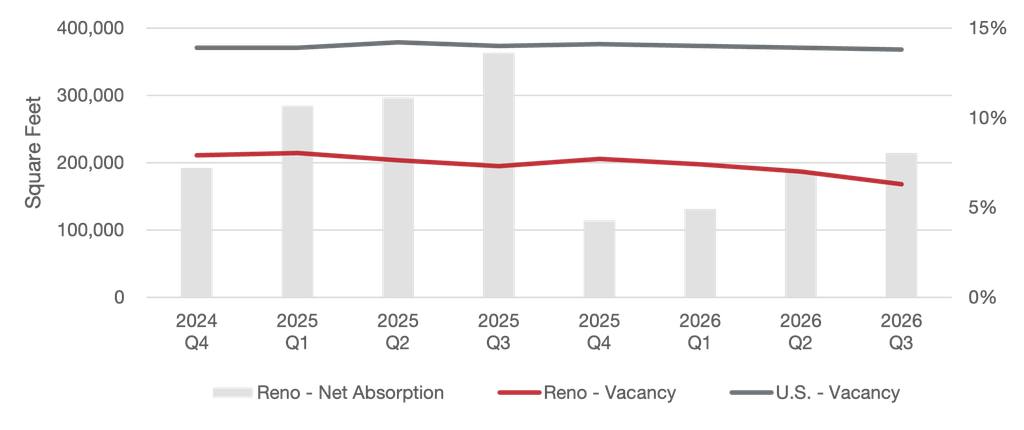
Leasing conditions continued to tighten as available inventory declined to approximately 1.4 million square feet. Office space in Reno remains on the market an average of 7.1 months, roughly half the national average of 13.6 months, reflecting a more competitive environment for tenants. With fewer move-in-ready options available, tenants planning relocations or expansions over the next year may face less flexibility in both space selection and rental negotiations. Landlords offering well-located, move-in-ready space remain best positioned to capture demand, while tenant improvement packages continue to play an important role in leasing decisions.
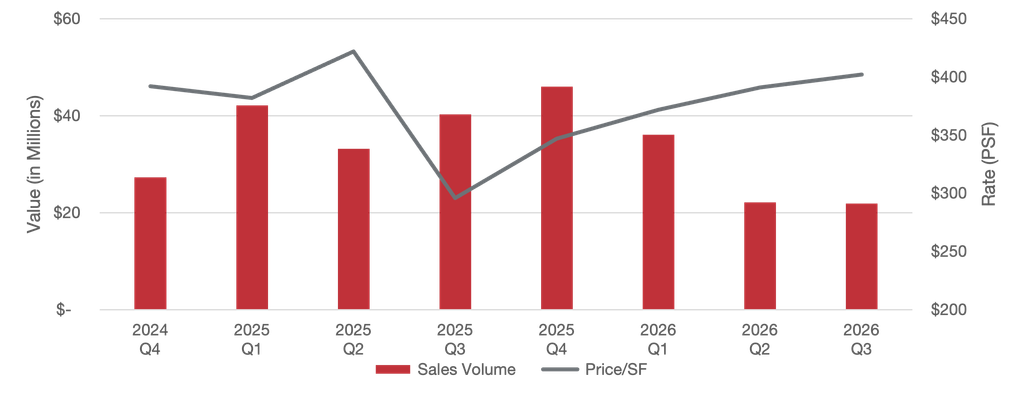
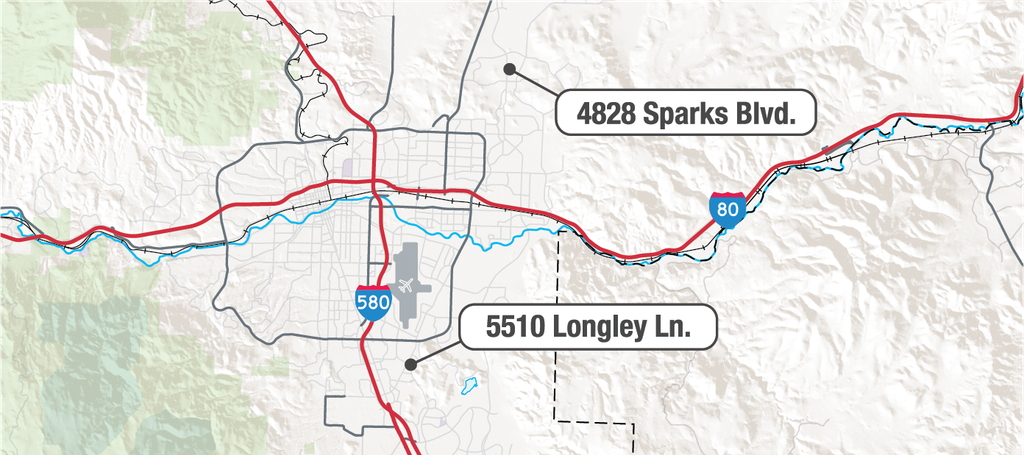
Office sales activity remained relatively stable in the third quarter, with eleven qualifying transactions totaling $21.9 million, compared with thirteen sales and $22.2 million last quarter. The average sale price increased modestly to $402 per square foot from $391 per square foot in Q2. Financing costs remain a significant challenge, with loan rates near 7.0% making many traditional investor acquisitions difficult to justify without creative deal structures. The quarter’s largest transaction was 5510 Longley Lane, which sold for $3.96 million, or $350 per square foot. Medical office properties continued to command premium pricing, with a newly constructed condominium at 4828 Sparks Boulevard selling for $541 per square foot.
New office construction remains constrained by elevated development costs, with approximately 205,000 square feet currently underway and the largest project still well short of completion. Ground-up Class A office development can cost approximately $600 per square foot, with even well-connected local developers facing costs near $400 per square foot. At the higher end of that range, new projects require full-service rents approaching $4.00 per square foot to justify construction, significantly above Reno’s average asking rent of $2.24 per square foot. This gap continues to limit new development and reinforces the competitive position of existing office inventory.
With construction costs limiting new supply, competition is increasingly concentrated among existing buildings. Landlords willing to invest in tenant improvements and property upgrades should remain better positioned to attract tenants, particularly as available space continues to decline. Until rental rates rise sufficiently to support new development or construction costs moderate, existing inventory is expected to accommodate most near-term office demand.
Employment Trends
According to the Nevada Department of Employment, Training and Rehabilitation’s (DETR) most recent economic data, job growth in the state increased by 1.6%, or 25,300 jobs, over the last 12 months. The latest report for the Reno-Sparks market showed an increase of 0.3% (1,000 jobs) since last month, bringing year-over-year job growth to 1.8% (5,000 jobs). Nevada’s seasonally adjusted unemployment rate is currently reported at 4.7%, a decrease of 10 basis points since last month and 50 basis points below the same period last year, though still 50 basis points above the national average of 4.2%.
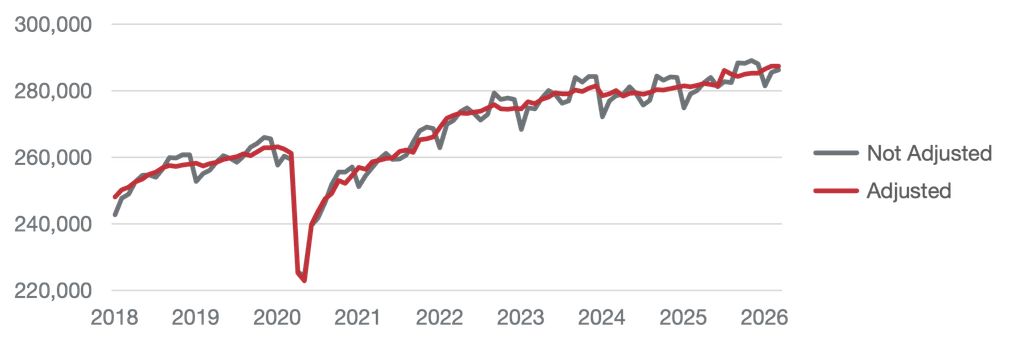
Job growth was led by education and health services, professional and business services, and trade, transportation, and utilities. The continued expansion of professional and business services is particularly supportive of office demand, while growth in education and health services reinforces demand for medical and administrative office space. Although financial activities and government recorded declines, gains across several key sectors continue to support tenant demand and reinforce the stable fundamentals underpinning Reno’s office market.
Outlook
Reno’s office market is expected to remain tight heading into 2027, supported by limited new supply, steady tenant demand, and vacancy well below regional and national averages. Continued industrial and data center expansion may generate demand from engineering, legal, financial, and administrative firms serving those industries. With construction costs limiting development, existing buildings are expected to capture most near-term demand, placing upward pressure on rents for well-located space. Landlords offering move-in-ready suites and competitive tenant improvement packages should remain best positioned to attract tenants. These conditions distinguish Reno as one of the more resilient office markets in the Western U.S.
Regional Trends
Office markets across the Western U.S. continue to show mixed performance, with tenant demand increasingly concentrated in newer, higher-quality buildings. Salt Lake City reports that 4- and 5-star properties account for most of its absorption, while Phoenix removed approximately 1.4 million square feet of obsolete office inventory through demolitions over the past year. New construction remains limited across the region as elevated financing costs continue to constrain speculative development. Tenant improvement allowances remain a primary leasing incentive, ranging from approximately $20 per square foot in Las Vegas to $60 per square foot in Phoenix.
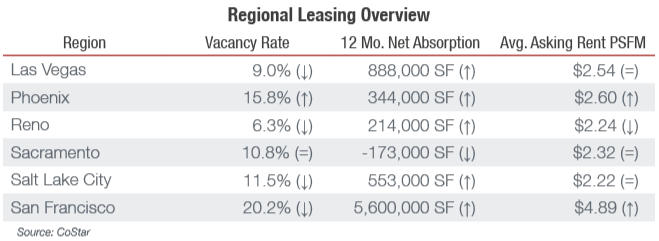
Regional absorption trends remain uneven. San Francisco recorded approximately 5.6 million square feet of positive net absorption over the past 12 months, supported by AI and technology firms, although vacancy remains elevated at 20.2%. Las Vegas and Salt Lake City also posted positive absorption, while Sacramento recorded negative absorption of ±173,000 square feet. Phoenix continues to face elevated vacancy at 15.8%. Reno remains the tightest office market among its Western peers, with vacancy at 6.3%, nearly three percentage points below Las Vegas, the next lowest market in the comparison.
Prepared By
Led by Dan Oster, Broker of Record and a Founding Partner of NAI Alliance, the Office Team provides expertise in investment sales, owner-user acquisitions, tenant representation, and project leasing throughout Northern Nevada. Since entering commercial real estate in 2004, Dan has built his practice around understanding each client’s strategic, financial, and operational objectives to deliver long-term real estate solutions. He earned the SIOR designation in 2015 and brings an analytical perspective shaped by a background in corporate information systems and 14 years as an adjunct professor teaching Advanced Supply Chain Management in the University of Nevada, Reno’s MBA program.
Dan is supported by Simon Solaegui, Associate, and Eric Hansen, Research Analyst, who provide market research, analysis, and transaction support to clients across the Reno office market. Together, the team combines decades of brokerage experience with current market intelligence to help owners, investors, landlords, and tenants make informed real estate decisions.